
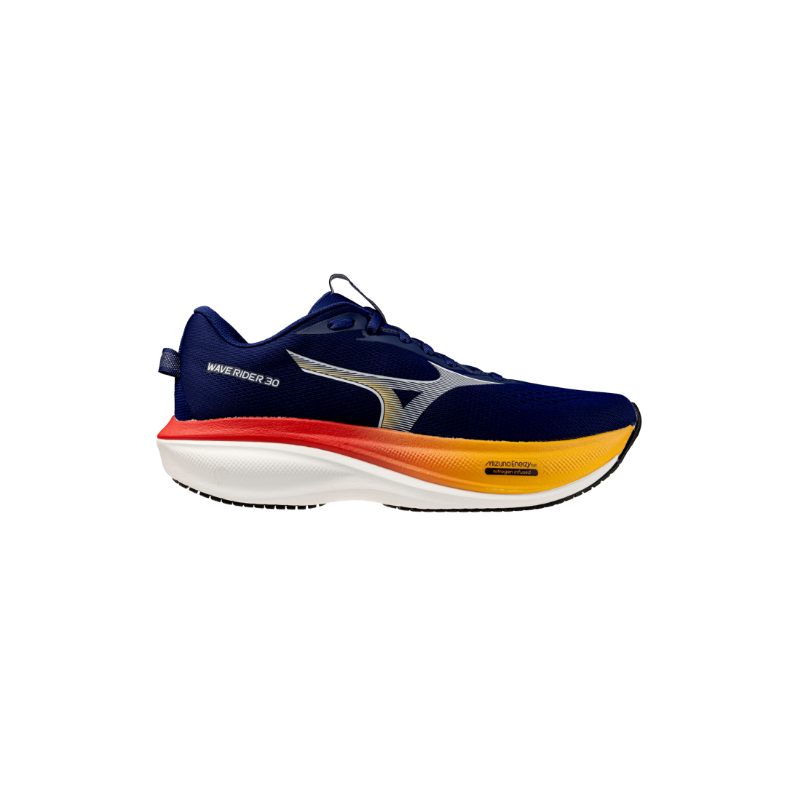
The Mizuno Wave Rider 30 is a major redesign of Mizuno’s neutral daily trainer. It combines a taller platform, an 8 mm drop, a dual-construction Enerzy NXT midsole and, for the first time in the series, a full-length Mizuno Wave plate.
Shop the Mizuno Wave Rider 30 on TrippSport.fr. Actual weight can vary with size and measurement protocol.
Technical specifications
| Feature | Wave Rider 30 | Expected effect |
|---|---|---|
| Category | Neutral daily trainer | Easy runs through long runs |
| Upper midsole | Nitrogen-infused Enerzy NXT | Softer initial compression |
| Lower midsole | Enerzy NXT with differentiated firmness | Platform control |
| Plate | Full-length Mizuno Wave | Organised flex and transition |
| Drop | 8 mm | Versatile geometry |
| Stack | 42.5 / 34.5 mm | High volume of cushioning |
| Claimed weight | 265 g | Protective daily-trainer balance |
| Upper | 1BY1 mesh and shaped heel | Targeted hold and ventilation |
Why use two Enerzy NXT constructions?
Nitrogen-infused Enerzy NXT sits close to the foot to provide softer compression and progressive rebound. Beneath it, a second Enerzy NXT construction uses different firmness zones to control the tall platform. The design separates immediate comfort from structural support.
Energy return should not be interpreted as a guaranteed performance gain. Shoe mass, geometry, speed and the individual runner all influence the outcome. Published work suggests that softer and more resilient cushioning can reduce energetic cost under some conditions, but no precise percentage should be assigned to this specific model without direct testing.
A full-length Wave plate, not a carbon racing plate
The Wave plate distributes midsole deformation and helps the foot move continuously from heel to toe. It primarily structures a high stack rather than copying the very stiff carbon plates used in racing shoes. Reviews of longitudinal bending stiffness show that effects depend on speed, plate shape, foam and runner characteristics.
High stack and inherent stability
At roughly 42.5 mm in the heel, the Rider 30 contains substantial cushioning. Tall, soft shoes can feel unstable if their base and structure do not control deformation. The differentiated lower layer, Wave plate and redesigned outsole are intended to address this.
The Rider remains neutral. Runners wanting more medial guidance should read our Wave Inspire 22 analysis.
What does an 8 mm drop mean?
An 8 mm offset sits between low-drop shoes and traditional 10–12 mm designs. It can accommodate heel and midfoot landings without imposing an extreme transition. A six-month randomised trial involving 553 runners found no overall significant injury-risk difference between 0, 6 and 10 mm shoes, although results varied with running habits. Drop should therefore not be selected in isolation or changed abruptly. See our guide to heel-to-toe drop.
Ride characteristics
Easy running
The high foam volume and structured transition prioritise regular, protective mileage.
Long runs
The stack preserves cushioning as fatigue develops, while the plate organises flex through the shoe.
Faster running
At 265 g, the Rider 30 can handle controlled accelerations. A lighter performance model will remain preferable for very fast sessions and racing.
Cornering
As with any tall shoe, control depends on base width, upper hold and the runner’s loading pattern. A dynamic test provides more information than squeezing the foam by hand.
Wave Rider 30 vs Saucony Ride 19
| Criterion | Wave Rider 30 | Saucony Ride 19 |
|---|---|---|
| Position | Tall, structured neutral trainer | Lighter, flexible neutral trainer |
| Foam | Dual Enerzy NXT construction | PWRRUN+ |
| Structure | Full-length Wave plate | Geometry-led transition |
| Drop | 8 mm | 8 mm |
| Claimed men’s weight | 265 g | Approximately 255 g |
| Feel | Protection and organised roll | Flexibility and lighter turnover |
These are genuinely comparable daily neutral shoes. The Saucony Ride 19 should feel more direct, while the Rider 30 offers more height and a more structured transition.
Who should choose the Wave Rider 30?
- neutral runners seeking daily protection;
- runners who like guided transitions without medial support;
- athletes accustomed to a medium drop;
- easy, long and aerobic runs;
- runners wanting one shoe that can also manage controlled faster efforts.
Fit, comfort and individual choice
The preferred movement path concept indicates that shoes may alter joint trajectories less than older rigid classification systems implied. Comfort and compatibility with a runner’s natural movement therefore matter, although no single criterion predicts the ideal shoe.
Leave sufficient toe space, check heel security and avoid excessive instep pressure. A gait analysis at Tripp Sport allows several models to be compared under consistent conditions.
Tripp Sport technical verdict
FAQ
Is the Wave Rider 30 a stability shoe?
It has good inherent stability but remains neutral. The Wave Inspire 22 provides more specific guidance.
Is the Wave plate carbon?
No. Its primary role is to structure the sole and transition.
Can it be used for a marathon?
Yes, when comfort has been confirmed during long training runs.
What changed from the Rider 29?
The Rider 30 introduces a taller stack, 8 mm drop, full-length Wave plate and revised Enerzy NXT construction.
Shop the Mizuno Wave Rider 30 at TrippSport.fr.