
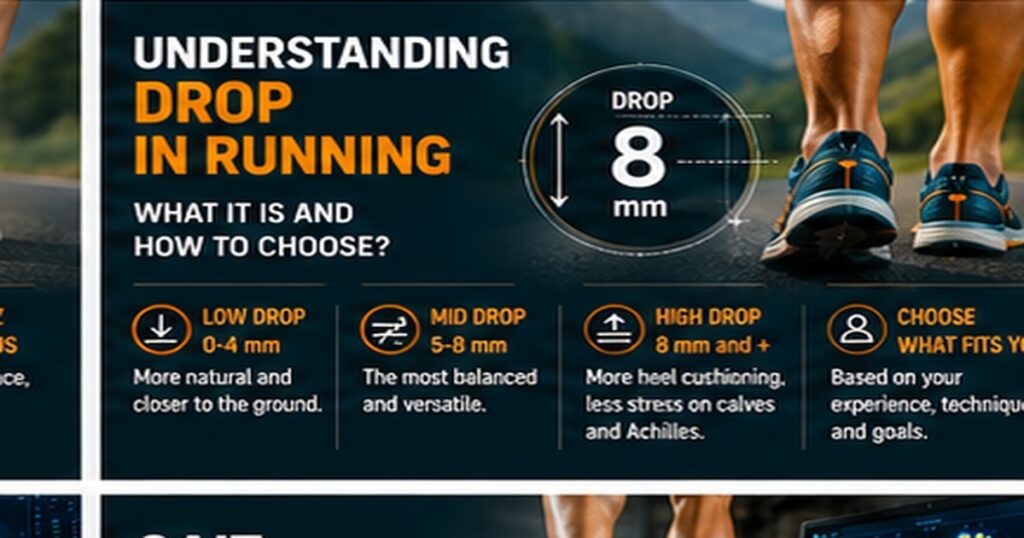
Heel-to-toe drop is one of the figures you will find on almost every running-shoe specification sheet: 0 mm, 4 mm, 6 mm, 8 mm, 10 mm, 12 mm…
But this number is often given more importance than it deserves.
Contrary to some common beliefs, there is no universally superior heel-to-toe drop for running, and this measurement alone cannot determine the best shoe for an individual runner.
What is heel-to-toe drop?
Heel-to-toe drop is the difference in height between the heel and the forefoot of a shoe.
For example, if a shoe measures 36 mm under the heel and 28 mm under the forefoot, its drop is 8 mm.
Drop should not be confused with total stack height. A shoe can have a very thick midsole and a low drop, while another can sit much closer to the ground and still have a higher drop.
Low, medium or high drop
There is no universal scientific classification, but these practical ranges can help when comparing shoes:
- 0 to 4 mm: relatively low drop;
- 5 to 8 mm: intermediate drop;
- 9 to 12 mm or more: relatively high drop.
These categories are useful for comparison. They do not mean that one category is inherently better than another.
Does drop change running gait?
It can influence certain biomechanical variables and how mechanical loads are distributed.
However, the relationship is not as simple as “low drop = forefoot strike” and “high drop = heel strike”.
Foot-strike behaviour also depends on running speed, habits, individual anatomy, fatigue, terrain and the overall geometry of the shoe.
Drop is therefore only one of several factors that may influence running mechanics.
Does a low drop reduce injury risk?
Current evidence does not show that low-drop shoes provide universal protection against running injuries.
One randomised controlled trial followed 553 recreational runners for six months. Participants used similar running shoes with heel-to-toe drops of 0, 6 or 10 mm.
Overall, injury risk was not significantly different between the three groups.
This is an important finding: there is no evidence that one particular drop is best for every runner.
Is a low drop more “natural”?
The word “natural” is frequently used in running, but it can be misleading.
The human body has a considerable capacity to adapt, and what a runner tolerates depends partly on what they are accustomed to.
A runner who has spent several years in 10 or 12 mm drop shoes may notice a substantial change when suddenly moving to 0 or 4 mm.
This does not mean that low-drop shoes are bad. It means that a meaningful change in mechanical loading may require time to adapt.
Drop redistributes loads rather than making them disappear
This is probably the most important concept to understand.
Changing shoe geometry does not eliminate mechanical loads. Instead, it may alter how those loads are distributed across different structures.
Depending on the shoe and the individual running pattern, loading may change around the foot, ankle, calf, Achilles tendon or knee.
It is therefore misleading to describe one geometry as inherently “good” and another as inherently “bad”.
Two 8 mm shoes can be completely different
Drop should never be considered in isolation.
A running shoe’s behaviour also depends on:
- total stack height;
- foam density and resilience;
- rocker geometry;
- stiffness;
- platform width;
- heel geometry;
- forefoot flexibility;
- overall stability.
Two shoes with exactly the same stated drop can therefore produce very different sensations.
Should you change your heel-to-toe drop?
Not necessarily.
If you regularly run in a shoe that works well for you, that experience is valuable information.
You do not need to move to a lower drop simply because it is presented as more modern or more natural.
Likewise, runners who are accustomed to low-drop footwear do not need to move away from it if they tolerate it well.
If I change drop, should I transition gradually?
When the change is substantial, a progressive transition is reasonable.
Moving suddenly from a geometry you have used for years to a very different shoe may change the demands placed on different tissues.
A gradual introduction gives the body time to adapt, particularly when several characteristics change at once, such as drop, stiffness, stack height, foam or rocker.
Can I use shoes with different drops?
Yes.
A runner can use a comfortable shoe for easy runs, a more dynamic shoe for faster sessions and another model for racing.
They do not necessarily need to have exactly the same heel-to-toe drop. What matters most is that the runner tolerates each shoe appropriately.
Which drop should you choose?
There is no magic number.
Consider:
- what you currently run in;
- your sensations;
- your type of running;
- the overall geometry of the shoe;
- your running history;
- how different shoes feel when you try them.
What about gait analysis?
Dynamic gait analysis can help observe how a runner behaves in different shoes.
It can complement the runner’s own sensations, but it cannot calculate a scientifically proven “ideal drop”.
What is gait analysis used for? →
In summary
Heel-to-toe drop is simply the difference in height between the heel and the forefoot.
It can influence how a shoe behaves and how loads are distributed, but a low drop does not automatically mean better running mechanics, and a high drop does not automatically make a shoe unsuitable.
No single drop has been shown to reduce injuries for every runner. The complete geometry of the shoe matters more than one isolated number.
Your own experience and sensations therefore remain important, with a gradual transition when making a substantial change in shoe geometry.
Main scientific source
Malisoux L et al. Influence of the Heel-to-Toe Drop of Standard Cushioned Running Shoes on Injury Risk in Leisure-Time Runners: A Randomized Controlled Trial With 6-Month Follow-up. American Journal of Sports Medicine, 2016.