
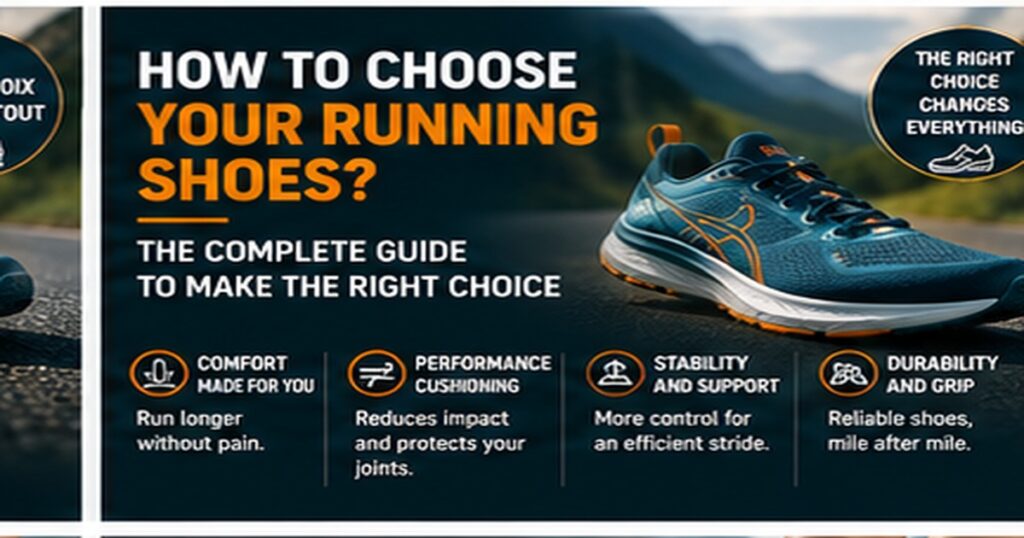
Choosing running shoes can quickly become confusing. Maximum cushioning or a firmer ride? Neutral or stability shoes? Low or high heel-to-toe drop? Lightweight or protective?
The first thing to remember is simple: there is no single best running shoe for every runner.
Your choice should take into account your running habits, experience, terrain, foot shape, personal preferences and what you actually expect from the shoe.
Scientific research also suggests being cautious with older rules that automatically matched shoes to arch shape or to a simple “pronator / neutral / supinator” classification.
1. Start with the way you run
Before looking at technologies and specifications, ask yourself a few questions:
- How many times do you run each week?
- What distances do you usually cover?
- Do you mainly run on roads, paths or trails?
- Are you training for a 10K, half marathon, marathon, or mainly running for enjoyment?
- Do you need a shoe for easy runs, faster sessions or an all-round daily trainer?
- What shoes are you currently using, and how do they feel?
Someone running twice a week for 45 minutes does not necessarily need the same type of shoe as a runner training five times a week for a marathon.
The runner’s individual context should come before the shoe’s technical specifications.
2. Cushioning: more is not automatically better
Modern running shoes use increasingly sophisticated foams that can be thick, lightweight and responsive.
A large amount of cushioning may provide a welcome feeling of protection, particularly during longer runs. However, a highly cushioned shoe is not automatically more suitable and should not automatically be considered more protective against injury.
Some runners prefer a very soft ride. Others feel more comfortable with a firmer platform or a shoe that provides greater ground feedback.
Recent research suggests that overall shoe appreciation and perceived cushioning may be associated with injury risk. This does not prove that comfort “prevents” injury, but it supports the idea that the runner’s own perception is useful information when choosing shoes.
3. Do not choose shoes based only on pronation
Pronation is a natural movement of the foot during running.
For many years, running-shoe advice was often based on a simple model: pronating foot = stability shoe, neutral foot = neutral shoe, supinating foot = cushioned shoe.
Scientific evidence does not support applying this rule systematically to every runner.
Trials involving thousands of participants have not demonstrated a clear injury-prevention benefit from assigning running shoes solely according to arch height.
This does not mean stability shoes are useless. Some randomised trials have found potential benefits from motion-control features for certain groups of runners.
The reasonable conclusion is therefore neither “stability does nothing” nor “every pronating runner needs a stability shoe”.
Shoe selection should be individualised.
4. Heel-to-toe drop is only one part of the shoe
Heel-to-toe drop is the difference in height between the heel and forefoot.
A shoe might have a drop of 4, 6, 8, 10 or 12 mm, for example. But this number alone does not tell you how the shoe will behave.
Two shoes with an 8 mm drop can feel completely different because of their overall stack height, foam properties, stiffness, platform width, rocker and general geometry.
It is therefore better to consider drop as one characteristic among many.
What is heel-to-toe drop in running shoes? →
5. Fit and foot volume are essential
An excellent shoe on paper can become a poor choice if it does not fit your foot correctly.
Pay particular attention to:
- space in front of the toes;
- forefoot width;
- heel hold;
- the absence of uncomfortable pressure points;
- the overall internal volume of the shoe.
Your feet can also increase slightly in volume during exercise. It is therefore perfectly normal for your running-shoe size not to match your everyday shoe size exactly.
Most importantly, two running shoes labelled with the same size can fit very differently.
6. Body weight alone does not determine the right shoe
It is still sometimes suggested that a heavier runner automatically needs a highly cushioned, rigid shoe.
That rule is far too simplistic.
Body weight can influence sensations and mechanical loads, but running speed, experience, training volume, terrain, previous injuries and personal preferences also matter.
Two runners of the same weight may be comfortable in very different shoes.
7. Your running history matters
Running-related injuries are complex and multifactorial. A runner’s history is therefore useful information when selecting footwear.
It is worth considering:
- which shoes you have previously used;
- which models worked well;
- which shoes caused discomfort;
- whether you are accustomed to particular drops or shoe geometries.
A new running shoe is never introduced into a completely blank context.
8. Try several models
Technical specifications can help create a shortlist. They cannot tell you exactly how a shoe will feel on your foot.
Comparing several models allows you to assess comfort, fit, perceived stability, transition, cushioning and available space.
A very popular running shoe may simply not suit your foot or your preferences.
9. What is the role of gait analysis?
Gait analysis can provide additional information when it is used carefully.
It can help observe a runner in several different shoes and compare certain aspects of movement. However, it should not be treated as a machine capable of identifying “the perfect shoe” with certainty.
At Tripp Sport, the aim is therefore to combine your sensations + your running habits + your history + trying different shoes + dynamic observation.
What is gait analysis used for? →
Quick checklist before buying
- Identify your main terrain: road, path or trail.
- Decide whether the shoe is for easy runs, long runs, faster sessions or all-round use.
- Check toe room, forefoot width and heel hold.
- Make sure there are no pressure points when standing or jogging.
- Compare several models rather than choosing from specifications alone.
- Pay attention to how stable, smooth and natural the shoe feels.
- If you change drop or geometry significantly, introduce the new shoe progressively.
- Choose the model that best matches your own sensations and running habits.
In summary
When choosing running shoes, do not look for a magic formula.
You can also explore our selection of men’s running shoes and women’s running shoes.
A good running shoe should above all suit your activity, your foot, your preferences, your usual running habits and the terrain and distances you plan to cover.
Pronation, heel-to-toe drop, cushioning and shoe weight are useful pieces of information, but none of them should be used alone to make the decision.
At Tripp Sport, our approach is therefore less about finding “the best running shoe” and more about finding the shoe that makes the most sense for the runner standing in front of us.
Scientific sources
- Knapik JJ et al. Injury-reduction effectiveness of prescribing running shoes on the basis of foot arch height. Journal of Orthopaedic & Sports Physical Therapy, 2014.
- Malisoux L et al. Injury risk in runners using standard or motion control shoes. British Journal of Sports Medicine, 2016.
- Peterson B et al. Biomechanical and Musculoskeletal Measurements as Risk Factors for Running-Related Injury in Non-elite Runners. Sports Medicine – Open, 2022.