
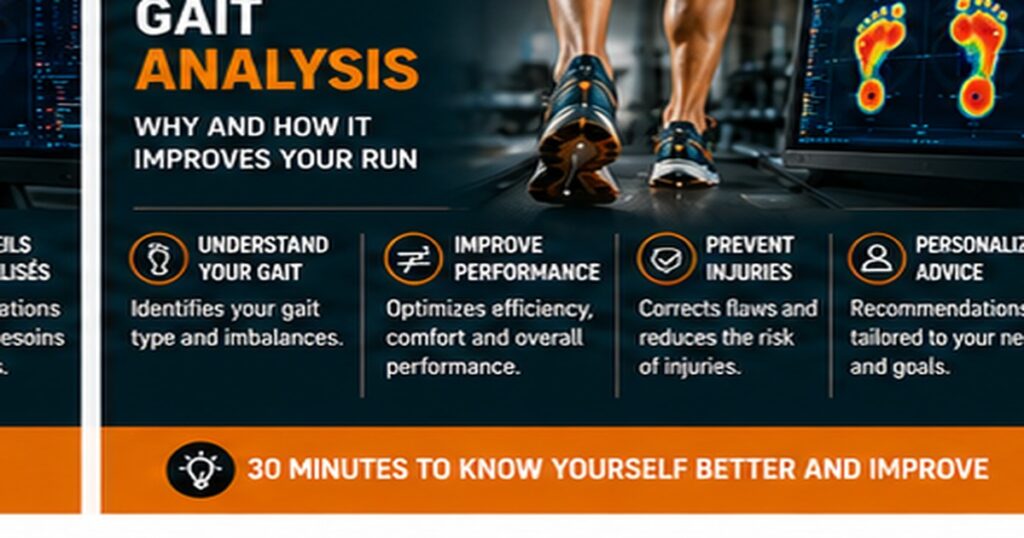
Gait analysis allows us to observe a runner while they run.
That sounds simple, but interpreting what we see requires caution.
Video analysis can provide useful information when comparing different running shoes and understanding certain aspects of movement. However, it cannot predict an injury with certainty or automatically determine the perfect running shoe.
This distinction is important when using gait analysis responsibly.
Gait analysis is first and foremost an observation tool
When observing someone running, we can look at several elements:
- foot strike;
- the way the foot moves through stance;
- certain movements of the foot and ankle;
- overall stability;
- some asymmetries;
- cadence;
- differences observed between several pairs of shoes.
Video makes it possible to slow the movement down and examine certain details more easily.
But what we see must always be interpreted in context.
Pronation is normal
Pronation is often one of the first terms associated with gait analysis.
However, pronation is not an abnormality. It is a natural movement involved in normal foot function.
The useful question is therefore not simply: “Does this runner pronate?”
It is more relevant to consider how the runner moves, to what extent, how they feel, whether they feel stable and whether their sensations change between shoes.
Reducing gait analysis to a “pronator / neutral / supinator” classification is too simplistic.
Can gait analysis predict an injury?
This is where scientific evidence calls for considerable caution.
Systematic reviews examining numerous biomechanical variables in runners have found that most individual measurements do not, on their own, predict future running-related injuries sufficiently well.
Certain factors may be associated with particular injuries or populations, but results are often inconsistent.
Gait analysis should therefore never be used to claim:
“You move like this, therefore you are going to get injured.”
That conclusion would go beyond what the scientific evidence supports.
Why are running injuries so difficult to predict?
Because they are multifactorial.
Risk may be influenced by many factors, including:
- previous injury history;
- changes in training load;
- recovery;
- sleep;
- training frequency and intensity;
- running experience;
- physical capacity;
- terrain;
- and, in some cases, biomechanical factors.
A few seconds of video cannot therefore summarise an individual runner’s complete injury risk.
So what is gait analysis useful for in a running store?
For something much more practical: observing and comparing.
Imagine a runner trying three different shoes.
The first may feel unstable. The second may appear to provide more support but feel too rigid. The third may feel both comfortable and smooth.
Video analysis can then be used as an additional piece of information alongside the runner’s own sensations.
It should not replace what the runner feels.
Your sensations matter
A gait pattern that looks “perfect” on video is of little value if the runner feels uncomfortable in the shoe.
Conversely, some visible characteristics may simply be part of that individual runner’s normal movement and may be perfectly compatible with pain-free running.
The goal is not to make every runner move in exactly the same way.
Should you change your running gait?
Not automatically.
Seeing something on video does not mean it needs to be changed immediately.
Deliberately modifying running technique can alter certain biomechanical variables. However, that does not automatically mean the change will reduce long-term injury risk.
Any gait modification should therefore have a clear purpose and be introduced progressively.
Gait analysis and choosing running shoes
This is probably where gait analysis makes the most sense in a specialist running store.
We can combine:
- your running habits;
- your previous shoes;
- your sensations;
- your foot;
- your goals;
- trying several models;
- dynamic observation.
This is much more useful than allowing a single measurement to make the decision.
Is gait analysis a medical diagnosis?
No.
Gait analysis carried out as part of running-shoe selection does not replace assessment by a doctor, physiotherapist, podiatrist or another appropriately qualified healthcare professional.
If pain persists or an injury is suspected, the role of the running store is not to provide a medical diagnosis.
The Tripp Sport approach
At Tripp Sport, we prefer to use gait analysis as a decision-support tool, rather than as a machine that dictates which shoe a runner must wear.
The discussion starts with the runner: training, goals, history, previous shoes and sensations.
Then come shoe testing and observation.
It is the combination of this information that helps guide the choice.
Discover how gait analysis works at Tripp Sport →
Book a gait analysis at Tripp Sport →
Tripp Sport
30 rue de Boyeffles
62160 Aix-Noulette
France
How to prepare for your gait-analysis appointment
A few simple details can make the appointment more useful and more representative of your actual running:
- bring your current shoes or an older pair you know well, if possible;
- wear the socks you normally use for running;
- know roughly your weekly mileage, usual distances and typical terrain;
- mention positive or negative sensations you experienced in previous shoes;
- explain your goal: returning to running, 10K, half marathon, marathon, trail or everyday comfort.
The appointment is most useful when your experience, sensations and several shoe models can be compared, rather than trying to reach a conclusion from one video image alone.
In summary
Gait analysis can be useful for observing running movement, comparing several shoes, helping runners understand some of their sensations and adding information to the shoe-selection process.
However, by itself it cannot predict every injury, diagnose a medical condition, scientifically identify one unique perfect shoe or classify every runner into three simple categories.
The most useful approach is therefore also the most reasonable:
observe, compare, listen to the runner and interpret each piece of information in context.
Scientific sources
- Dingenen B et al. Biomechanical Risk Factors Associated with Running-Related Injuries: A Systematic Review. Sports Medicine, 2019.
- Peterson B et al. Biomechanical and Musculoskeletal Measurements as Risk Factors for Running-Related Injury in Non-elite Runners: A Systematic Review and Meta-analysis. Sports Medicine – Open, 2022.