
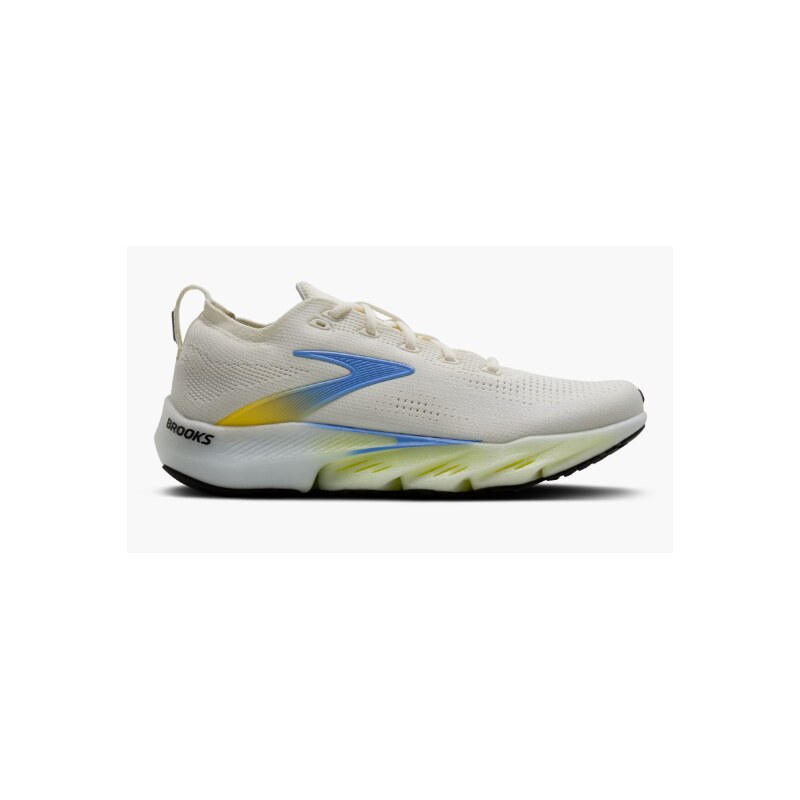
The Brooks Glycerin Flex is a neutral road-running shoe designed to combine premium comfort with greater freedom of movement. Its defining feature is the FlexZone™ geometry under the midfoot, which lets the platform bend more naturally as pressure moves from landing to toe-off.
Technical specifications
| Feature | Brooks Glycerin Flex men |
|---|---|
| Category | Neutral road running shoe |
| Main use | Daily training, long runs, active walking and gym |
| Declared drop | 6 mm |
| Key technology | FlexZone™ midfoot flex groove |
| Ride | Soft landing, flexible transition, moderately lively toe-off |
| Rigid plate | No |
| Terrain | Road, treadmill and smooth dry paths |
Actual weight can vary with size and colour. Fit, geometry and comfort in motion are more useful selection criteria than a few isolated grams.
How FlexZone™ changes the ride
Highly rigid shoes use their own geometry to control the roll forward. The Glycerin Flex follows another path: the midfoot groove allows local deformation as the centre of pressure travels forward. Runners who find strong rockers overly directive may appreciate this more organic transition.
Flexibility does not mean a complete lack of structure. The platform, upper and continuous ground contact still provide intrinsic stability, but the foot is allowed to articulate without a plate or forced tipping sensation.
6 mm drop and running mechanics
A 6 mm drop sits between very low-drop shoes and traditional 10–12 mm trainers. It does not automatically produce a midfoot strike: speed, fatigue, slope, technique and previous habits have a larger influence on foot strike.
Research by Malisoux and colleagues indicates that injury risk depends on the runner’s history and on the match between shoe, practice and individual profile. Nigg’s preferred-movement-path paradigm likewise supports choosing a comfortable shoe that does not unnecessarily constrain a runner’s habitual motion.
Expected performance
Cushioning
The ride is tuned for soft, consistent contact over daily and longer mileage, rather than the aggressive rebound of a racing model.
Transition
This is the shoe’s signature strength. FlexZone™ makes the heel-to-midfoot-to-forefoot progression less monolithic and allows the forefoot to work naturally.
Stability
This remains a neutral shoe without a medial correction system. Stability comes mainly from the platform, upper hold and continuous contact. Runners needing stronger guidance should consider the Brooks Adrenaline GTS or Mizuno Wave Inspire 22.
Speed
The flexible forefoot can feel lively during short accelerations, but there is no carbon plate. The shoe is best suited to easy-to-steady mileage and versatile training.
Compare with the Saucony Ride 19
Both cover similar daily-training use, but the Glycerin Flex places more emphasis on midfoot freedom and flexibility, while the Ride 19 aims for broader versatility with a more rocker-led transition.
| Criterion | Glycerin Flex | Ride 19 |
|---|---|---|
| Position | Premium comfort and flexibility | Balanced, versatile daily trainer |
| Drop | 6 mm | 8 mm |
| Feel | Free flexion and soft contact | More conventional, responsive transition |
| Best for | Runners prioritising natural midfoot flex | Runners seeking an all-round workhorse |
Choose the Glycerin Flex when freedom of movement matters most; choose the Ride 19 when you want a more universal shoe across different sessions.
Who should choose it?
- neutral runners seeking a comfortable daily shoe;
- athletes who prefer flexibility to a pronounced rocker;
- runners accustomed to medium drops or willing to transition gradually;
- people using one pair for running, walking and gym work;
- runners wanting more foot articulation without moving to a minimalist shoe.
Fit advice
Leave roughly a thumb’s width in front of the longest toe and try the shoe with your usual running socks. The heel should remain secure without excessive pressure across the metatarsals.
Shop the Brooks Glycerin Flex at Tripp Sport
Independent measurements
RunRepeat measured the Glycerin Flex at about 264 g, with 35.2 mm in the heel and 25.9 mm in the forefoot. Their protocol found high shock absorption — 143 SA in the heel and 109 SA in the forefoot — but lower energy return at about 49.1% / 51.3%.
Measured flexibility was 12.2 N, making it more flexible than a regular Glycerin without turning it into an extremely bendable shoe. The measured fit is also on the narrow side, so trying it on remains important.
Additional sources: RunRepeat and Doctors of Running.
Frequently asked questions
Is it a stability shoe?
It offers intrinsic platform stability but remains neutral; it does not replace a dedicated support shoe.
Can it handle a half marathon?
Yes, provided the fit and comfort have been validated during long runs. Faster racers may prefer a lighter competition geometry.
Is it suitable for beginners?
Yes. Beginners moving from a higher drop should increase volume progressively.