
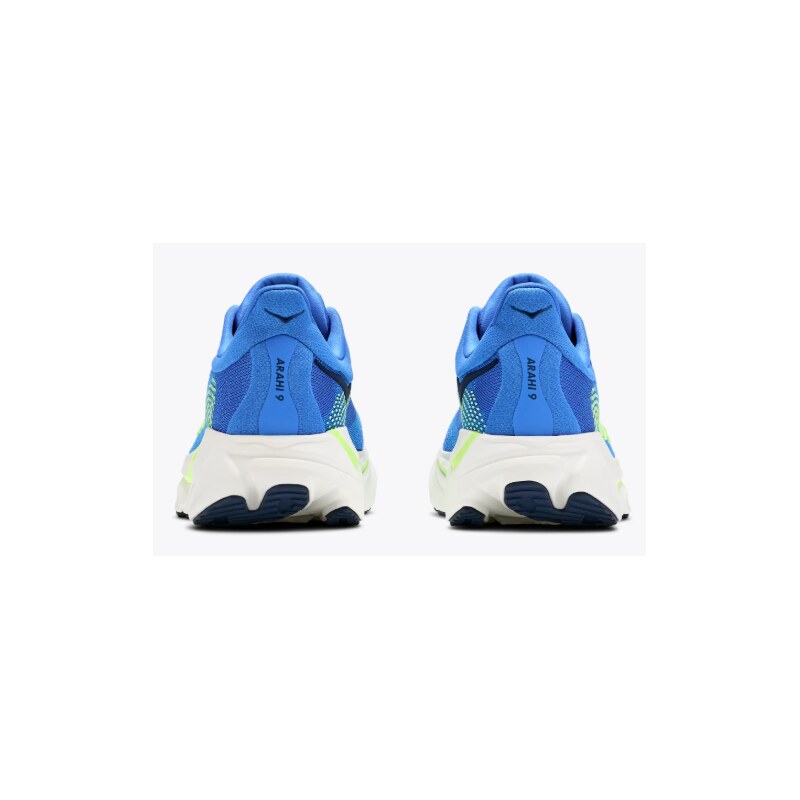
The Hoka Arahi 9 is a stability running shoe designed to guide the stride without a traditional medial post. Its H-Frame, wide base and Active Foot Frame support a consistent platform, while the 8 mm drop makes it accessible for daily mileage.
Hoka Arahi 9 positioning
The Arahi 9 targets runners seeking moderate stability for easy runs, daily training and longer outings. It can also suit neutral runners who prefer a structured platform. Its priority is predictable support rather than racing speed.
| Feature | Hoka Arahi 9 men |
|---|---|
| Use | Road, daily training, endurance and active walking |
| Stability | Moderate, H-Frame and wide base |
| Claimed weight | 284 g |
| Claimed drop | 8 mm |
| Midsole | Dual-density compression-moulded EVA |
| Geometry | Active Foot Frame and MetaRocker |
How does H-Frame stability work?
H-Frame combines firmer elements around softer foam. The frame limits excessive deformation and slows inward collapse without forcing one rigid path. The wide platform also improves inherent stability.
This approach is consistent with the Preferred Movement Path concept: footwear should support the runner’s habitual motion. Comfort and perceived stability during running therefore remain essential selection criteria.
Cushioning, transition and efficiency
The EVA midsole favours consistency over dramatic bounce. MetaRocker assists the heel-to-toe transition. At 284 g, it remains reasonable for a stability shoe, though faster runners may prefer the Mach 7.
An 8 mm drop offers a familiar transition. Any significant change in drop should still be introduced progressively because it redistributes load across the foot, calf, knee and hip.
Compare with the Saucony Guide 19
Both target runners looking for moderate guidance in daily training. The Arahi 9 uses H-Frame and a rolling MetaRocker geometry, while the Saucony Guide 19 relies more on its broad CenterPath platform and a subtler support feel.
Choose the Arahi 9 for more noticeable structured guidance and rocker; choose the Guide 19 for a broader, more natural-feeling platform.
Who is it for?
- runners seeking moderate stability without a rigid correction;
- runners who experience instability or medial collapse under fatigue;
- daily mileage and long runs;
- neutral runners who enjoy a structured platform;
- active walking.
Our shoe-choice advice at Tripp Sport
We would recommend the Arahi 9 to runners who want to feel reassuring guidance underfoot while keeping a smooth transition for easy runs and long runs. It becomes particularly relevant when very soft neutral shoes feel unstable.
We would look at another model first if your priority is lightness and speed for faster sessions, or if you prefer very subtle stability. In that case, the Saucony Guide 19 is worth comparing directly.
Fit and sizing
Allow room in front of the toes, check heel lockdown and ensure the midfoot feels secure without compression. Feet often expand during longer runs, so testing later in the day can be useful.
View the Hoka Arahi 9 at Tripp Sport
Tripp Sport verdict
The Arahi 9 modernises the stability category: guidance is noticeable but less intrusive than a traditional medial post. It is a strong option for confident daily mileage when the fit and geometry match the runner. A gait analysis at Tripp Sport in Aix-Noulette helps compare it with similar models.
Recent independent measurements and feedback
Independent 2026 testing adds useful context to HOKA’s specifications. One review reports about 275 g in a men’s US 9, roughly 39 mm heel / 31 mm forefoot and an 8 mm drop. Version 9 keeps the H-Frame concept while improving upper breathability and slightly softening the ride compared with the Arahi 8.
Additional sources: Alastair Running and RTINGS.
FAQ
Is the Arahi 9 only for overpronators?
No. It can also suit neutral runners who simply prefer a more structured and stable platform.
Is it suitable for long runs?
Yes. Its cushioning, broad base and moderate guidance make it particularly coherent for easy mileage and longer outings.
How does it differ from the Guide 19?
The Arahi 9 provides more noticeable structured guidance and rocker; the Guide 19 feels broader and more progressive.