
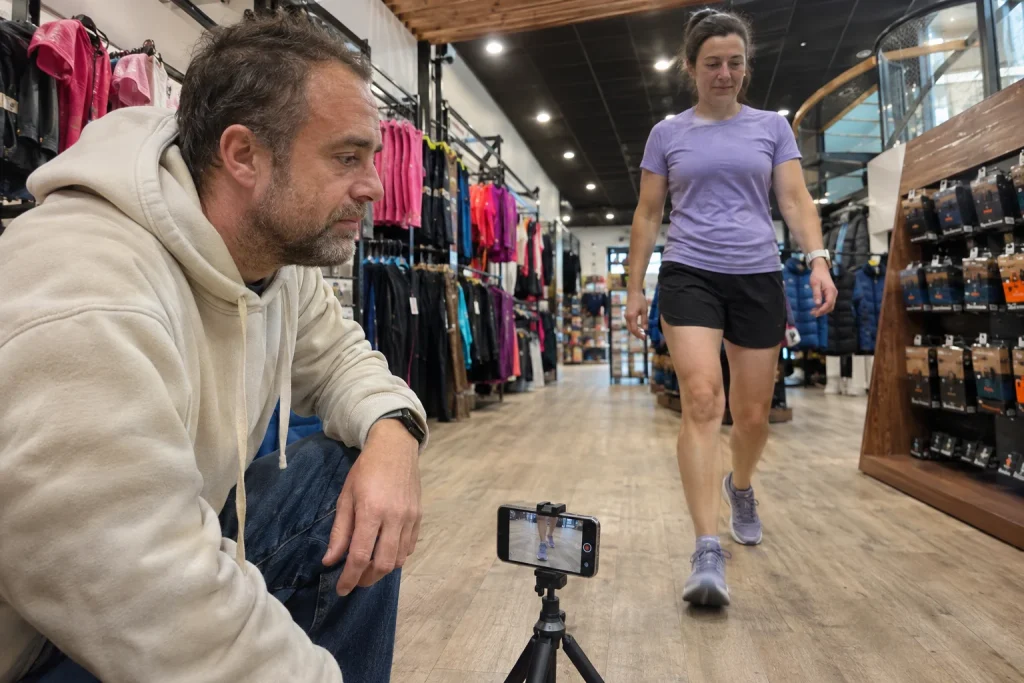
You might recognise the scene. You jog a few steps, watch the replay, and the heel of the shoe seems to lean inward. You try another pair and the movement looks smaller. It is natural to wonder whether something is wrong with your foot. The video gives us something to talk about. On its own, it cannot tell us what your foot is doing inside the shoe or which pair will suit you over time.
What can move beneath you
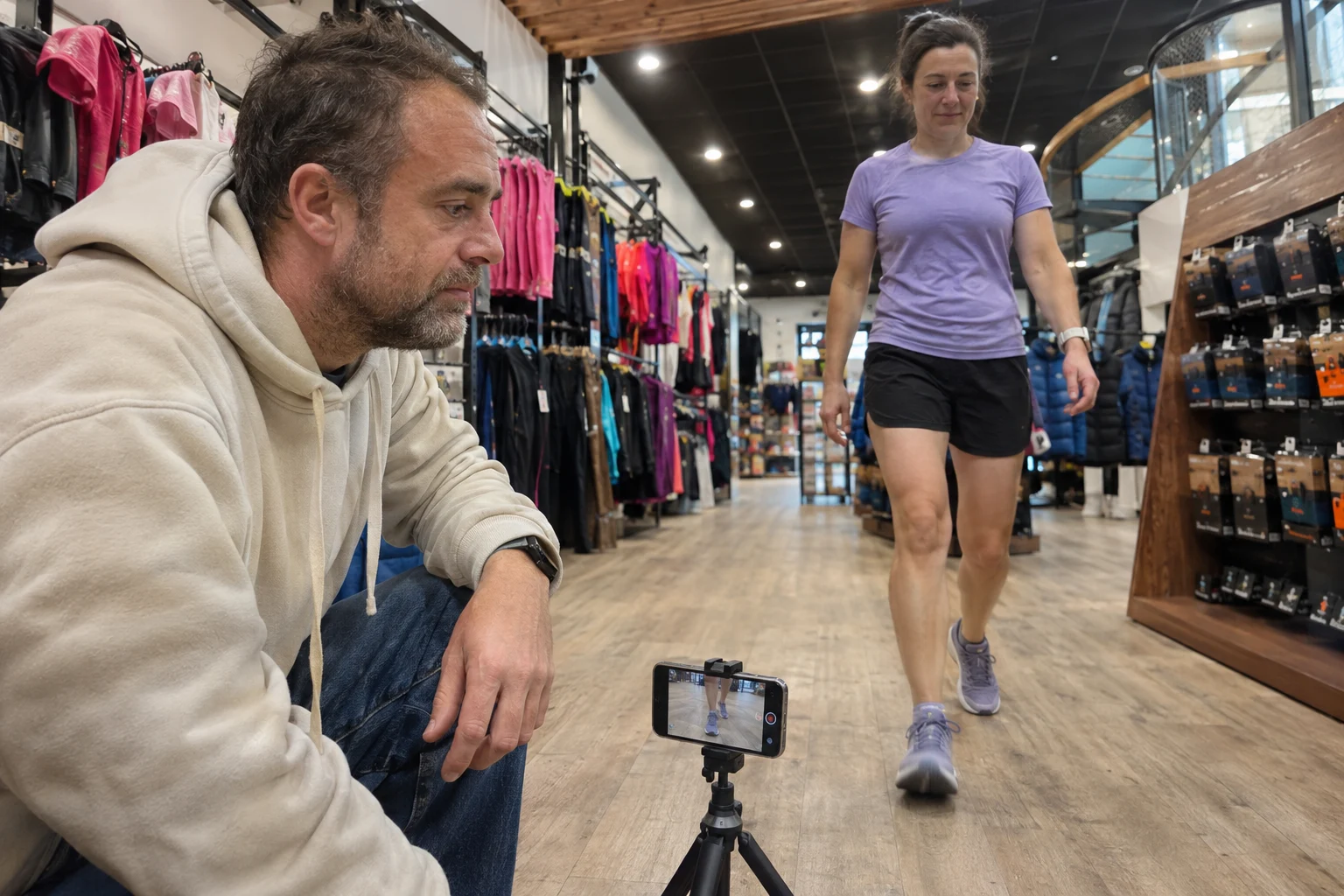
Pronation is a combined movement of the foot that can be part of an ordinary stride. From behind, you see only part of it, such as the orientation of the rearfoot. Sometimes what you see is mainly the shoe. The fabric around the heel can move relative to the foot, and the sole can compress unevenly. These movements may happen at the same time, but they are different. A freeze frame at the point of greatest tilt tells you little about how the foot landed or how it pushed off.
- 1. Foot
Watch several steps. A freeze frame can exaggerate a movement.
- 2. Sole
Look for uneven compression, then compare with the other pair.
- 3. Shoe
Ask whether the runner feels their heel moving inside the upper.
Why two shoes can look different on camera
Imagine two shoes in your size. In one, you feel your foot move towards the inside edge as you load it. In the other, with a firmer, lower sole, you feel closer to the ground and the tilt is less apparent. Uneven compression is one possible explanation. Base width, the shape of the sole, heel hold and how the upper wraps around your foot may also differ. A tall shoe with a wide platform can feel steady. A lower shoe may feel less secure if the heel slips. The comparison shows that the two foot-and-shoe combinations behave differently in this particular trial.
Two shoes, two different signals
In pair A, the inside edge compresses and you feel your heel move. In pair B, the shoe looks straighter on video, but you curl your toes to keep it in place. Repeat the same easy pass with comfortable lacing. Compare heel hold and toe room before deciding what the image means.
Now imagine that pair B feels more secure and still leaves your toes room. This time the video and your experience point in the same direction. That makes the pair worth trying again. If the shoes also differ in shape, width and height, the comparison cannot isolate the foam.
How we would compare two pairs in Aix-Noulette
Bring your usual shoes and running socks. Tell us when the concern comes up: after ten minutes, around a bend, downhill or from the first step. Try both pairs at an easy pace on the same surface, keeping the camera in the same place. Watch several steps on each side. Before looking at the clip, describe what you felt: heel slip, pressure at the forefoot, an uncertain landing or a natural stride. Then watch the footage. If a pair looks straighter but pinches your toes or makes you want to alter your stride, take that into account. If the pair you already own feels good and the video is your only concern, there is room to talk it through before deciding whether to change.
When the video and your feet disagree
Imagine two passes along the same pavement. In your first pair, the outer view shows the sole tipping inwards, yet your foot feels secure. In the second, the heel looks more upright, but you grip with your toes at every turn. If you are choosing a daily trainer, the sensation you can reproduce matters more than the most flattering frame.
Pronation is part of how your foot moves through a step. A rear view can pick up compression of the foam, movement of the heel collar and movement around the ankle. It is hard to separate them from the outside. Switching to a lower, firmer shoe may also change base width and heel hold. You can prefer the new feel without knowing which feature made the difference.
Rule out the pavement, the laces and the worn lining
Try both sides on level ground. Repeat at your normal pace, then return to the first pair. A sloping pavement and a walking-only test answer different questions. If the right heel slips only in your old shoes, compare the lining on both sides. A compressed lining is a clue about the fit. It tells you little about how your foot moves in another pair.
When both shoes are comfortable and only the picture differs, compare the fit and the terrain you run on. If recurrent pain changes how you run, pause the fitting experiment and seek health advice. Bring both pairs to Tripp Sport if you want to show exactly where you feel the movement.
- Same socks, surface and pace
- Two passes in each pair
- Note what you feel every time
When to seek another opinion
A difference on video can guide a fitting. If pain persists, keeps returning or changes how you run, speak to a healthcare professional. Your usual shoes and the clip can help describe what you are experiencing. At Tripp Sport, a filmed fitting is a way to compare shoes and discuss how each pair feels.