
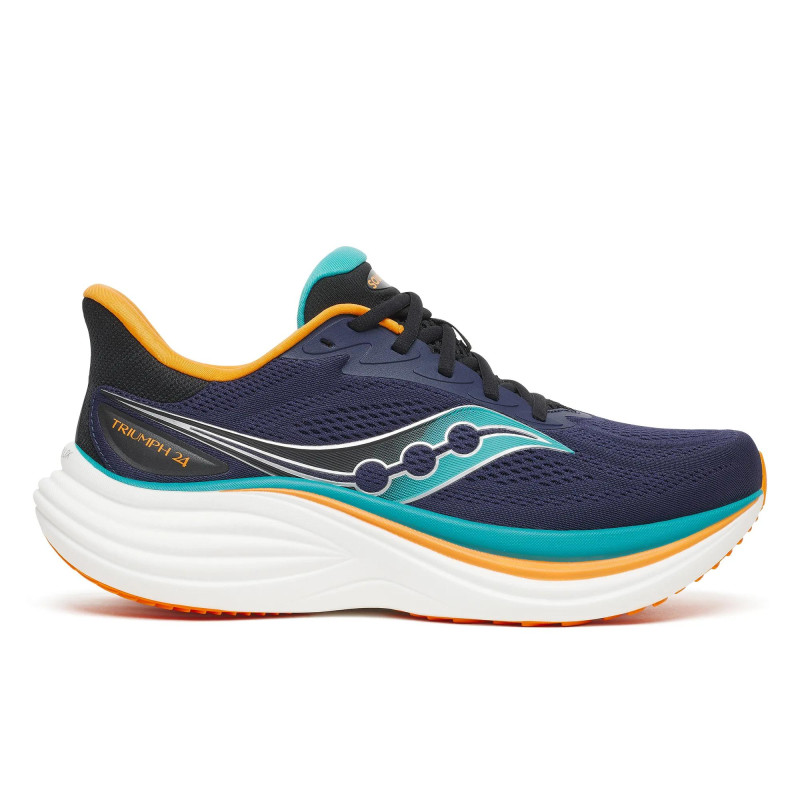
The Saucony Triumph 24 is a premium neutral daily trainer built for comfort without feeling lifeless. Its incrediLUX midsole, 40/30 mm stack and 10 mm drop target easy runs, long runs and high-mileage weeks. This analysis explains what those specifications mean in practice.
Positioning: protective mileage shoe
The Triumph 24 belongs to the highly cushioned neutral category. It has no propulsive plate and no corrective stability device. Instead, a broad platform, secure heel and controlled foam deformation provide intrinsic stability for runners who do not need extra guidance.
| Feature | Saucony Triumph 24 men |
|---|---|
| Primary use | Road, daily training, long runs and recovery |
| Midsole | Full-length incrediLUX |
| Stack | 40 mm heel / 30 mm forefoot |
| Drop | 10 mm |
| Claimed weight | Approximately 250 g in the men’s reference size |
| Stability | Neutral, with a broad inherently stable platform |
| Outsole | XT-900 carbon rubber in high-wear zones |
| Upper | Breathable mesh with a padded fit |
How incrediLUX changes the ride
incrediLUX is the central technical update. Saucony reports more cushioning material while reducing overall weight versus the previous generation. Under load, the foam compresses progressively: the first contact feels soft, while the wider base preserves enough resistance to avoid a collapsing sensation through mid-stance.
Softness alone does not guarantee better running economy. The outcome depends on foam deformation, shoe stiffness, speed and each runner’s mechanics. The Triumph 24 therefore aims for a useful compromise: obvious comfort at easy pace, a smooth transition and enough response for steady running, rather than the sharp rebound of a race shoe.
40/30 mm stack and 10 mm drop
The 40 mm heel provides a substantial cushioning reserve. A 10 mm offset gives a familiar geometry to many heel strikers and can reduce the relative demand placed on the calf–Achilles complex compared with a sudden move to a low-drop shoe. Drop does not dictate foot strike on its own; speed, geometry, fatigue and previous habits also matter.
Neutral stability and preferred movement
The Triumph 24 is neutral but not unstable. Its broad footprint, well-contained foam and locked-in heel create natural support. This suits many runners whose pronation remains compatible with their habitual movement. Runners with a strong need for guidance should compare it against a true stability shoe.
The preferred movement path concept suggests that a suitable shoe should work with the runner’s characteristic motion instead of forcing an arbitrary correction. A gait analysis at Tripp Sport helps compare several geometries while running.
Performance by session
Easy and recovery runs
This is its strongest area. The midsole reduces harshness and the padded upper promotes comfort. The stable platform also remains predictable when form deteriorates with fatigue.
Long runs
The cushioning reserve and XT-900 rubber are well matched to sustained mileage. Carbon rubber protects exposed zones, while the 10 mm drop keeps transitions accessible late in a run.
Faster running
The Triumph 24 can handle short controlled accelerations thanks to its moderate weight, but speed work is not its main purpose. Frequent intervals are better served by a lighter, more aggressive shoe.
Compare with the Brooks Glycerin 23
| Criterion | Triumph 24 | Glycerin 23 |
|---|---|---|
| Main focus | Soft comfort and lower weight | Plush comfort and natural stability |
| Drop | 10 mm | 8 mm |
| Best for | More agility over long distance | More planted support and upper security |
The Triumph 24 is lighter and easier to accelerate in; the Glycerin 23 feels more planted and supportive. Choose according to whether agility or a more secure platform matters most.
Who should choose it?
- neutral road runners building weekly mileage;
- runners prioritising comfort on easy and long sessions;
- those who prefer a traditional 10 mm drop;
- lighter and heavier runners seeking a reassuring platform;
- active walkers when the fit is appropriate.
It is less suitable for runners wanting strong ground feel, very high forefoot flexibility or a dedicated interval shoe.
Fit and sizing
Allow roughly a thumb’s width in front of the toes while standing. Test the shoe with normal running socks, preferably later in the day. The heel should stay secure without excessive pressure over the instep. Confirm the fit while turning, accelerating and running downhill.
Tripp Sport technical verdict
The Triumph 24 succeeds through balance: incrediLUX supplies premium softness, weight remains controlled and XT-900 supports durability. It is a strong choice for mileage, half-marathon or marathon training and recovery between demanding sessions.
View the Saucony Triumph 24 at Tripp Sport
Additional data from independent testing
Doctors of Running reports about 250 g in the men’s reference size, with 43 mm at the heel, 33 mm at the forefoot and a 10 mm drop.
The major update is IncrediLUX, a very soft ATPU-based foam that allows Saucony to deliver substantial cushioning without making the shoe heavy. Testers also highlight a gradual rocker and a sufficiently wide base to offset some of the foam’s deep compression.
Additional source: Doctors of Running, 2026 review. Values vary by size and testing protocol.
FAQ
Can it be used for a marathon?
Yes, especially when comfort and consistency matter more than outright racing speed.
Is it suitable for overpronation?
It is neutral. Pronation alone does not automatically require correction, but marked instability should be assessed dynamically.
Can it be used every day?
Yes. Daily training is its core purpose, provided training load is managed and the shoe is replaced once cushioning or outsole wear becomes significant.