
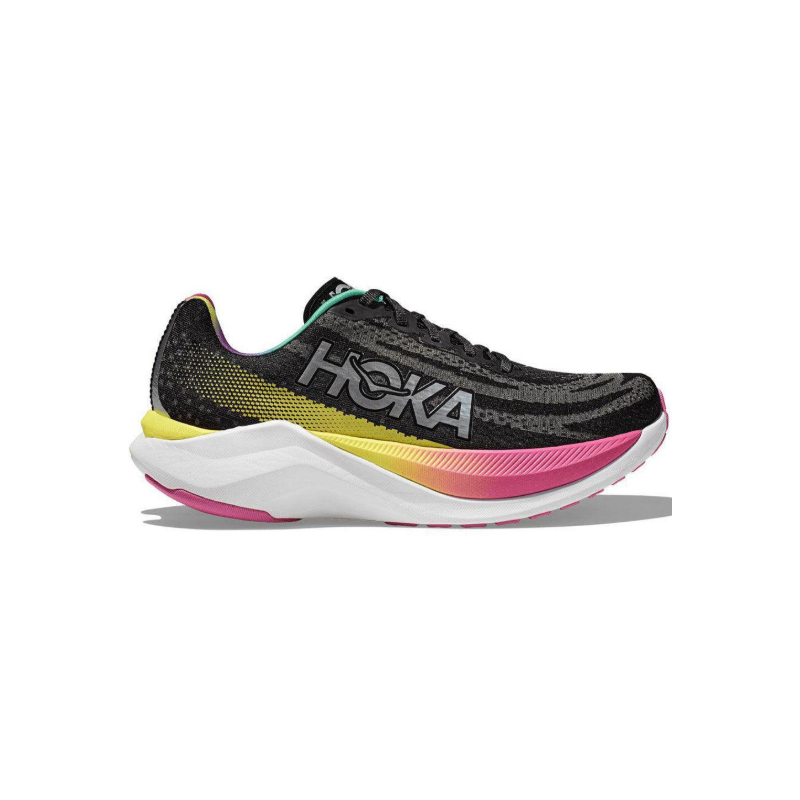
The Hoka Mach X 3 is a plated performance trainer that brings race-inspired mechanics into a more protective daily package. Its dual-density midsole places PEBA above a more stable carrier, paired with a Pebax plate and a speed-oriented MetaRocker.
Positioning: a super-trainer for quality sessions
It sits between a lightweight daily trainer and a racing shoe. The plate and PEBA increase longitudinal stiffness and rebound, while the lower layer provides the stability required for tempo runs and long sessions with faster blocks.
| Feature | Hoka Mach X 3 |
|---|---|
| Use | Road, tempo, threshold, long intervals and progressive long runs |
| Midsole | Dual density with PEBA top layer |
| Plate | Full-length Pebax |
| Drop | 5 mm |
| Geometry | Speed-oriented MetaRocker |
| Stability | Neutral, structured by the lower carrier |
| Outsole | Compression-moulded grippy rubber |
| Upper | Secure breathable mesh |
PEBA, Pebax plate and longitudinal stiffness
The PEBA top layer compresses quickly and returns part of the stored energy. The Pebax plate limits local bending, distributes load and helps the foot roll forwards. The lower carrier prevents the system from becoming excessively unstable.
A plate does not automatically improve running economy for every runner. The result depends on pace, geometry, ankle stiffness and forefoot loading. The Mach X 3 therefore reveals more of its benefit at sustained pace than during very slow running.
5 mm drop and MetaRocker
The 5 mm drop produces a relatively direct transition. MetaRocker moves the rollover point forwards and reduces the flexion required at the forefoot. Runners coming from a high drop may feel more calf demand and should adapt progressively.
Ride by session
Tempo and threshold
This is its strongest use. Rocker and plate quicken transition, while PEBA feels more responsive as loading increases.
Long intervals
It suits multi-minute repetitions and marathon or half-marathon pace blocks. Its protection is more relevant here than for very short sprints.
Easy and recovery running
It remains usable, but the rigid platform feels less natural at slow pace. A more flexible neutral shoe will usually be easier on recovery days.
Compare with the Saucony Endorphin Azura
| Criterion | Hoka Mach X 3 | Saucony Endorphin Azura |
|---|---|---|
| Construction | PEBA + Pebax plate | PWRRUN PB without a plate |
| Feel | More rigid and propulsive | More flexible and natural |
| Best for | Tempo, threshold and long fast sessions | Versatile faster running without plate stiffness |
The Mach X 3 imposes more of its geometry; the Endorphin Azura allows more natural foot flexion. The better option depends mainly on your tolerance for stiffness and preference for a guided or freer transition.
Who should choose it?
- neutral runners preparing for 10K, half-marathon or marathon
- athletes wanting a durable tempo and threshold shoe
- runners who enjoy a rolling transition and noticeable plate
- profiles already comfortable with moderate drop
It is less suitable for very slow recovery, runners wanting high flexibility or those who feel unstable on a tall rigid platform.
Fit and sizing
The mesh should secure the midfoot without compressing the metatarsals. Keep room in front of the toes and check heel hold as pace rises. Dynamic testing matters because a plate can magnify a poor size match.
Tripp Sport technical verdict
The Mach X 3 is a genuine fast-training tool: more protective than a racing shoe and more mechanical than a daily trainer. Its PEBA–Pebax–MetaRocker combination becomes most useful once pace creates enough load to exploit the geometry.
View the Hoka Mach X 3 at Tripp Sport
Laboratory measurements and Tripp Sport interpretation
RunRepeat measured the Mach X 3 at about 42.9 mm in the heel and 33.4 mm in the forefoot. Their protocol found an actual 9.5 mm drop, noticeably higher than Hoka's stated 5 mm, partly because the measurement methods differ.
The measured weight is about 264 g. Testing also shows strong shock absorption, with substantially better energy return in the forefoot than the heel: about 69.3% in the forefoot versus 58.9% in the heel. This helps explain why the shoe becomes more interesting when the runner loads the forefoot and increases pace.
Source: RunRepeat laboratory protocol, 2025-2026. Values vary by size and method.
FAQ
Can it be used for a marathon?
Yes, for runners preferring super-trainer protection over the minimal weight of a race shoe.
Is the plate carbon?
No. This model uses a Pebax plate, generally more compliant than a classic carbon plate.
Is it an everyday easy-run shoe?
It can be used daily, but its mechanics make more sense at moderate or fast pace.