
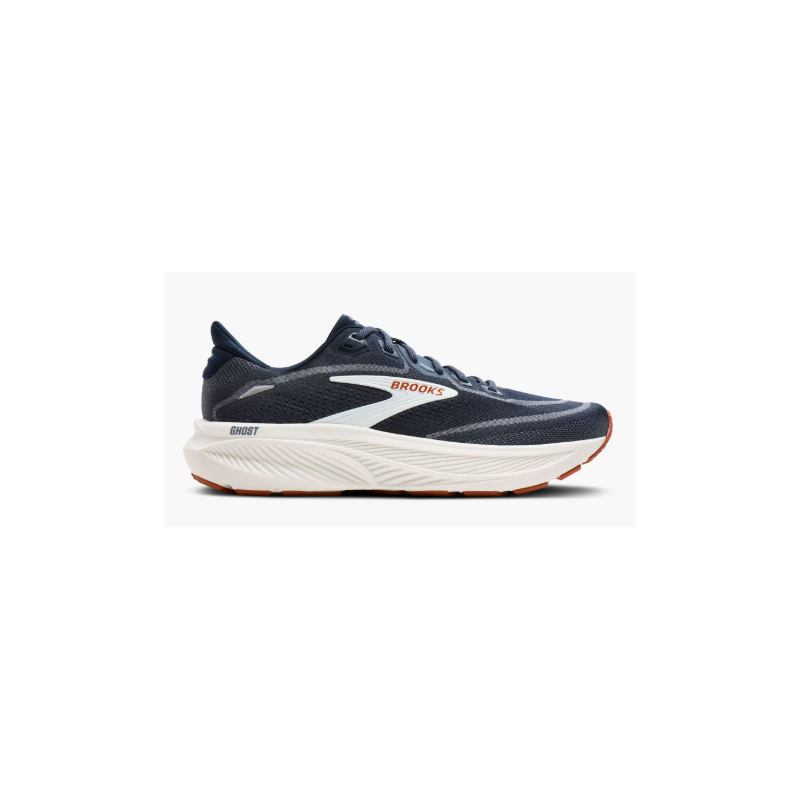
The Brooks Ghost 18 is a neutral road-running shoe designed for daily training. Its role is simple: provide a comfortable, predictable and durable ride for regular mileage.
Brooks combines nitrogen-infused DNA LOFT v3, a 10 mm stated drop, RoadTack rubber and a secure upper. The men’s reference weight is approximately 289.2 g.
Brooks Ghost 18 specifications
| Feature | Brooks Ghost 18 men |
|---|---|
| Main use | Road running, daily training and walking |
| Category | Neutral daily trainer with inherent stability |
| Midsole | Nitrogen-infused DNA LOFT v3 |
| Drop | 10 mm |
| Stated weight | 289.2 g |
| Outsole | RoadTack rubber |
| Plate | None |
| Best suited to | Easy runs, steady runs, regular mileage and long walks |
The absence of a plate and the conventional geometry make the Ghost 18 easy to use. It does not force the runner into an aggressive rocker or a very stiff transition.
DNA LOFT v3 cushioning: soft without feeling uncontrolled
DNA LOFT v3 is a nitrogen-infused foam. In the Ghost 18 it is tuned to combine a soft landing with enough structure to keep the platform predictable through stance. This distinction matters: cushioning can feel comfortable without being excessively soft or unstable.
The result is best suited to easy and moderate paces. The Ghost 18 can handle short accelerations, but it is not as light or aggressive as a shoe built for interval sessions or racing.
Can a neutral running shoe also be stable?
Yes. Neutral does not mean unstable. The Ghost 18 has no traditional medial post or corrective element. Its stability comes from the geometry of the platform, the secure heel, the continuous transition and the controlled behaviour of the foam.
Brooks describes this as balanced support: a secure rearfoot and a dynamic forefoot provide inherent stability without imposing a corrective motion. This may suit many neutral runners as well as runners who display normal physiological pronation without requiring additional guidance.
Pronation is a normal component of foot motion, not automatically a fault to correct. Scientific reviews show that the relationship between pronation, shoe design and injury risk is complex. Comfort, training history, workload and the runner’s individual response remain more useful than a single neutral-or-stability label.
What does the 10 mm drop mean?
Drop is the height difference between the heel and forefoot inside the shoe. At 10 mm, the Ghost 18 has a relatively traditional, higher drop.
It will often feel familiar to runners who already use medium- or high-drop shoes. For some runners, compared with a sudden switch to a very low-drop model, this geometry can reduce the mechanical demand placed on the ankle and calf–Achilles complex. It does not guarantee injury prevention. The effect depends on the runner, speed, foot strike, full shoe geometry and previous habits.
The practical rule is to avoid abrupt changes. A runner accustomed to a 10 or 12 mm drop will usually find the Ghost 18 easier to introduce than a sudden move to 4 mm.
Upper, heel hold and fit
The Ghost 18 uses a breathable upper, a new sockliner and a soft flat-knit tongue. The secure heel is important because it limits unwanted movement without trying to lock the foot rigidly in place. The forefoot should allow functional toe room while preventing the foot from sliding during turns or descents.
Try the shoe standing up, ideally later in the day and with your usual running socks. Leave enough room for the toes, while checking heel hold, midfoot volume and overall width. Length alone cannot determine the correct fit.
RoadTack outsole and durability
RoadTack rubber covers the main wear and traction zones. This reinforces the Ghost 18’s durability-focused positioning, although the rubber also contributes to its weight. It is intended primarily for asphalt, cycle paths and smooth dry tracks. It is not a substitute for a trail shoe on mud, rock or technical terrain.
There is no universal replacement mileage. Durability depends on runner mass, mechanics, surface, shoe rotation and localised wear. A clear loss of comfort, asymmetric deformation or unusual new discomfort can be more informative than a fixed kilometre threshold.
Who should choose the Brooks Ghost 18?
The Ghost 18 is particularly suitable for:
- easy and aerobic runs;
- regular daily mileage;
- long steady runs for runners who like balanced cushioning;
- gradual return to running with a predictable shoe;
- walking and long days on the feet;
- runners who want one versatile training pair.
It is less specialised for short, intense intervals, racing performance, highly technical trails or runners seeking a very light, low-to-the-ground feel.
It can be used for a 10K, half marathon or marathon when comfort has been validated during training. A lighter and more responsive shoe may still be preferable when race efficiency is the priority.
Compare with the Saucony Ride 19
Both are neutral daily trainers, but the Ghost 18 focuses more on steady comfort and secure fit while the Ride 19 feels lighter and more responsive.
| Feature | Brooks Ghost 18 | Saucony Ride 19 |
|---|---|---|
| Category | Neutral daily trainer | Neutral daily trainer |
| Midsole | DNA LOFT v3 | PWRRUN+ |
| Drop | 10 mm | 8 mm |
| Men’s stated weight | 289.2 g | 255 g |
| Main character | Balanced comfort and secure fit | Lighter, smoother and more responsive feel |
Choose the Ghost 18 if you prefer a secure, traditional daily trainer. Choose the Saucony Ride 19 if you want a lighter shoe with more pace versatility.
What the science actually says about cushioning and injury
No shoe can guarantee injury prevention. A randomised study involving 848 recreational runners found a higher injury risk in the firmer of two prototype shoes; the relative benefit of greater cushioning was mainly observed among lighter runners. This shows that cushioning can matter, but it cannot predict an individual’s outcome.
The comfort-filter and preferred-movement-path concepts support an individual approach: runners often favour shoes that feel comfortable and interfere little with their habitual motion. Training load, recovery and previous injury remain major factors.
Tripp Sport technical view
The Ghost 18 succeeds because of its overall balance rather than one spectacular technology. It combines comfortable cushioning, a predictable platform, secure fit and a road outsole built for regular use.
We primarily recommend it to runners who want a reliable daily shoe and already feel comfortable in a higher-drop geometry. If more structured guidance is required, the Guide 19, Brooks Adrenaline GTS or Mizuno Wave Inspire are more relevant options.
View the Brooks Ghost 18 at Tripp Sport and browse all men’s road-running shoes.
Independent measurements and Tripp Sport interpretation
RunRepeat measured the Ghost 18 at about 289 g, with a 37.3 mm heel stack, 25.1 mm forefoot stack and a 12.2 mm measured drop, higher than the brand figure. Shock absorption is clearly stronger in the heel, which supports its suitability for pronounced heel strikers.
Energy return remains moderate, so the Ghost 18 prioritises consistency, comfort and durability over maximum bounce. Its relatively broad heel platform and firm rearfoot structure also help explain its naturally stable feel for a neutral shoe.
Independent measurements: RunRepeat.
Frequently asked questions
Is the Ghost 18 a stability shoe?
It is a neutral shoe with inherent stability, not a structured guidance shoe.
What is the Ghost 18 drop?
The stated heel-to-forefoot drop is 10 mm.
How much does the men’s Ghost 18 weigh?
Brooks states approximately 289.2 g in the reference size. Actual weight changes with size.
Can you run a marathon in the Ghost 18?
Yes, when fit and comfort have been validated during long training runs. It prioritises reliability over the efficiency of a plated racing shoe.
Is it suitable for trail running?
Not for technical trails. It can handle smooth, dry tracks, but the outsole and upper are designed primarily for road use.
Sources
- Brooks Running. Men’s Ghost 18 – Product details. https://www.brooksrunning.com/en_us/mens/shoes/road-running-shoes/ghost-18/110493.html
- Nigg BM et al. Running shoes and running injuries: mythbusting and a proposal for two new paradigms. Br J Sports Med. 2015. https://pubmed.ncbi.nlm.nih.gov/26221015/
- Malisoux L et al. Shoe Cushioning Influences the Running Injury Risk According to Body Mass. Am J Sports Med. 2020. https://pubmed.ncbi.nlm.nih.gov/31877062/
- Agresta C et al. Running Injury Paradigms and Their Influence on Footwear Design Features. Front Sports Act Living. 2022. https://pubmed.ncbi.nlm.nih.gov/35356094/