
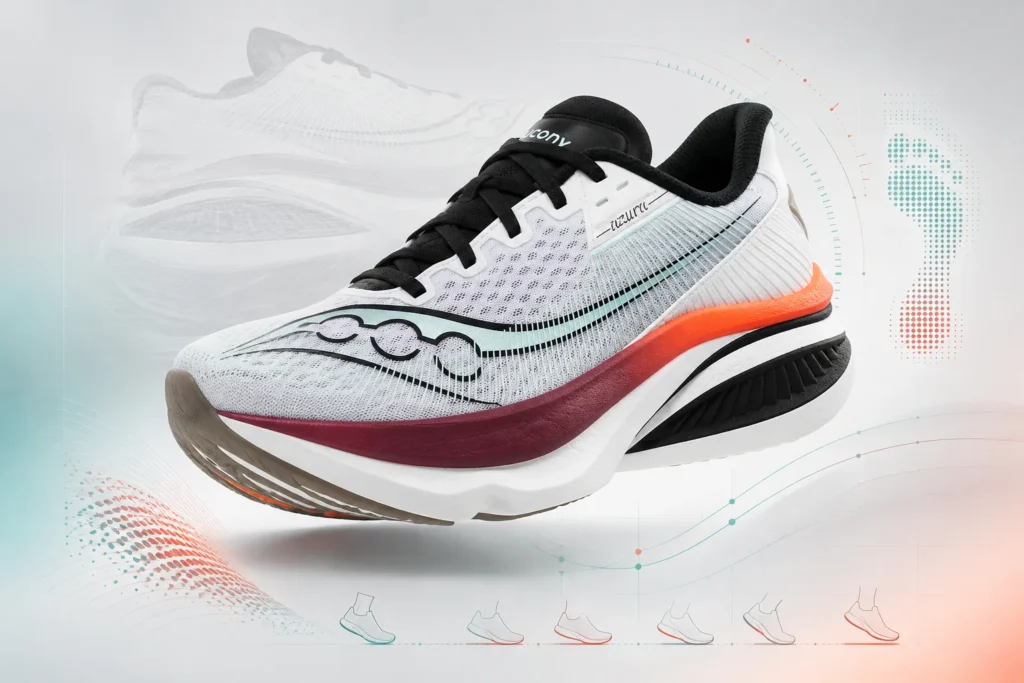
The Saucony Endorphin Azura is a neutral running shoe designed as a fast, versatile daily trainer. Saucony specifies a full-length PWRRUN PB midsole, SPEEDROLL geometry, an 8 mm drop, a stack height of 40 mm at the heel and 32 mm at the forefoot, and a men’s weight of about 240 g. Its defining feature is that it aims to deliver a lively ride without a carbon plate.
What can these specifications actually tell us about running biomechanics? This article deliberately separates three levels of evidence: manufacturer specifications, scientific findings on comparable footwear technologies, and reasonable biomechanical hypotheses for the Endorphin Azura. The studies cited below were not direct clinical trials of the Azura itself.
1. Technical features that can influence gait
- Foam: full-length PWRRUN PB.
- Geometry: SPEEDROLL rocker profile.
- Drop: 8 mm.
- Stack: 40 mm heel / 32 mm forefoot.
- Weight: approximately 240 g for men.
- Support: neutral construction.
- Carbon plate: none.
These parameters should not be interpreted in isolation. A running shoe is a mechanical system: foam deformation, longitudinal stiffness, sole curvature, shoe mass and the way an individual runner loads the shoe interact during every stance phase.
2. PWRRUN PB: rebound, compression and running economy
Modern high-resilience foams are designed to deform under load and return part of the stored mechanical energy during propulsion. That does not mean that every joule returned by the foam becomes extra forward speed. Running economy is an interaction between the runner and the complete footwear system.
A 2026 meta-analysis in the International Journal of Sports Medicine, including 17 randomized crossover trials, found that advanced footwear technology can reduce oxygen consumption and energetic cost compared with conventional running shoes. These findings apply to a category of footwear technologies and do not establish a specific percentage improvement for the Endorphin Azura.
PWRRUN PB can therefore plausibly contribute to a soft, energetic sensation, but the actual physiological benefit will depend on speed, body mass, running technique and individual response to the shoe’s geometry.
3. SPEEDROLL and rocker geometry
SPEEDROLL is based on a curved sole geometry. Scientific studies on rocker footwear show that this type of design can alter the progression of the centre of pressure and change ankle joint mechanics.
In a 2017 study by Sobhani and colleagues, rocker shoes reduced positive ankle work by about 16% and negative ankle work by about 32% compared with standard shoes. Peak plantar-flexion moment and impulse were also reduced. However, some knee mechanical variables increased. This is important: reducing mechanical demand at one joint may redistribute work elsewhere.
A 2025 systematic review of rocker-bottom footwear also reported changes in ankle kinematics and kinetics, including reductions in peak dorsiflexion, plantar-flexor moment and sagittal ankle range of motion in several rocker configurations.
For the Azura, SPEEDROLL can therefore reasonably be viewed as a geometry intended to smooth the heel-to-toe transition. It would be inappropriate, however, to claim that every runner will experience the same reduction in ankle work.
4. A fast shoe without a carbon plate
A key feature of the Endorphin Azura is the absence of a carbon plate. Modern racing “super shoes” typically combine a resilient foam, increased longitudinal stiffness from a plate and a carefully designed rocker geometry. Recent research suggests that plates can contribute to improved running economy, but they are not the sole explanation for the performance effect.
The Azura instead relies on the combination of PWRRUN PB + SPEEDROLL + low mass. This may appeal to runners who enjoy the feel of modern performance footwear but prefer a less rigid platform underfoot.
5. What does an 8 mm drop actually mean?
An 8 mm drop simply describes the difference between the advertised heel and forefoot stack heights. It does not determine foot strike. A runner can heel strike in a low-drop shoe or land on the midfoot in a higher-drop shoe.
Drop interacts with rocker geometry, total stack height, ankle mobility, speed and landing position. The overall behaviour of the shoe is therefore more informative than the drop number alone.
6. High stack: cushioning, leverage and stability
With 40 mm under the heel, the Azura is a high-stack shoe. More midsole material allows greater cushioning volume and may improve comfort during longer runs. At the same time, increasing the distance between the foot and the ground can change lever arms and lateral stability sensations.
Actual stability depends on platform width, sidewall geometry, foam stiffness and the runner’s own foot and lower-limb mechanics—not simply on stack height.
7. Which runners is it suited to?
Functionally, the Endorphin Azura is well positioned for neutral runners seeking one versatile shoe for:
- faster daily training;
- long runs at steady or progressive pace;
- tempo sessions;
- long intervals;
- selected races for runners who prefer a non-plated shoe.
Body weight alone should not determine suitability. Two runners of identical mass can load the same midsole very differently because cadence, leg stiffness, foot strike, ankle mobility and training history all affect mechanical demand.
Fit and sizing
The Endorphin Azura has a performance-oriented fit that should feel secure without compressing the toes. Check forefoot width, toe clearance and heel hold carefully, especially if you plan to use it for long runs or racing.
Because the rocker and high stack change how the foot sits in the shoe, sizing should be validated dynamically rather than from the label alone.
8. Rearfoot, midfoot or forefoot striker?
Rocker studies suggest that responses can differ according to strike pattern. In Sobhani’s study, some ankle-load reductions were greater in midfoot strikers than in rearfoot strikers. That does not mean the Azura should be prescribed only to one foot-strike type.
Rearfoot strikers may appreciate the high heel and rolling transition. Midfoot strikers may benefit from the foam and rocker during faster propulsion. For pronounced forefoot strikers, the experience will depend strongly on forefoot stiffness and metatarsophalangeal mobility.
9. Preferred Movement Path and individual response
Benno Nigg’s Preferred Movement Path work shows that average group changes in joint kinematics can be relatively small while individual responses are highly variable. This supports a personalized approach: the best running shoe is not necessarily the one with the most technology, but the one that works with the runner’s preferred movement pattern.
Advanced-footwear studies also demonstrate marked inter-individual variation in running economy. Some runners gain a large metabolic benefit, some gain very little, and a minority may even perform less economically in a given model.
Tripp Sport technical verdict
The combination of PWRRUN PB, SPEEDROLL, an 8 mm drop and a 40/32 mm stack gives the Azura a credible profile as a fast, versatile trainer. Its most interesting feature is the ability to provide a rolling, energetic ride without relying on carbon-plate stiffness.
We would recommend it if: you want a lively shoe for tempo sessions, steady long runs and faster training while keeping more freedom underfoot than with a plated shoe.
We would look at another model if: you prefer very soft cushioning, stronger guidance or a more rigid propulsive feel. In that case, the Triumph 24, Guide 19 or Mach X 3 may make more sense depending on your profile.
Biomechanically, the most plausible effects are a smoother forward transition and altered ankle work due to the rocker. Current evidence nevertheless argues against universal claims: there is no single percentage reduction in load or guaranteed improvement in running economy that can be applied to every Azura user.
11. Why gait analysis still matters
A technical specification sheet cannot predict exactly how a shoe will interact with your movement. At Tripp Sport, a gait analysis allows different models to be compared dynamically rather than selecting a shoe solely from drop, weight or foam reputation.
You can also view the Saucony Endorphin Azura product page for current availability and commercial specifications.
Further reading
- How to choose running shoes
- What is heel-to-toe drop in running shoes?
- What is gait analysis used for?
Independent measurements: why the Azura stands out
RunRepeat measured the Endorphin Azura at 40.7 mm in the heel, 32.7 mm in the forefoot and exactly 8.0 mm of drop. The measured weight was 241 g, remarkably low for such a high-stack shoe.
The most striking result is energy return: around 70.6% in the heel and 74.7% in the forefoot in their protocol. The forefoot platform is also about 123.4 mm wide, helping explain the shoe’s stability despite its performance-oriented character.
The laboratory nevertheless found the foam relatively firm. That matches the ride: the Azura is energetic and protective rather than plush. Its SpeedRoll rocker is also quite noticeable and may suit some running styles better than others.
Additional source: RunRepeat laboratory, 2026. Values depend on size and testing protocol.
FAQ
Does the Endorphin Azura have a carbon plate?
No. Its dynamic character comes from PWRRUN PB foam and SPEEDROLL geometry rather than a carbon plate.
Is it suitable for long runs?
Yes, particularly for runners who want a lively but protective shoe for steady or progressive long runs.
Is the Azura a soft shoe?
Not really. Independent measurements suggest a relatively firm foam, so the ride is energetic and structured rather than plush.
Scientific references
- Xiao Y, Hu X, Tian D, Qiu A. Effects of Advanced Footwear Technology on Running Economy and Endurance Performance: A Meta-Analysis. Int J Sports Med. 2026;47(2):81-94. PMID 40527489.
- Sobhani S, et al. Biomechanics of running with rocker shoes. J Sci Med Sport. 2017;20(1):38-44. PMID 27167559.
- Nigg BM, et al. The Preferred Movement Path Paradigm: Influence of Running Shoes on Joint Movement. Med Sci Sports Exerc. 2017;49(8):1641-1648. PMID 28277405.
- Nigg BM, et al. Running shoes and running injuries: mythbusting and a proposal for two new paradigms. Br J Sports Med. 2015;49(20):1290-1294. PMID 26221015.
- Effects of rocker-bottom shoes on the gait biomechanics of running and walking: A systematic review. Gait & Posture. 2025. PMID 40315809.
- Trama R, Blache Y, Hautier C. Effect of rocker shoes and running speed on lower limb mechanics and soft tissue vibrations. J Biomech. 2019. PMID 30389258.
Scientific note: this article is an evidence-informed biomechanical analysis based on published literature and Saucony’s technical specifications. It is not medical advice and does not prove that a specific biomechanical effect will occur in every Endorphin Azura user.