
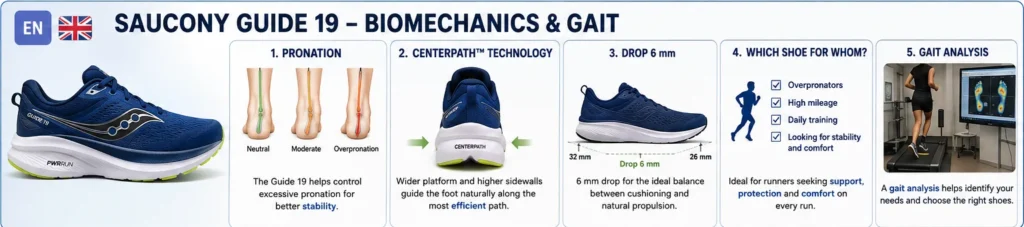
The Saucony Guide 19 is a good example of how modern stability running shoes have evolved. With PWRRUN cushioning, CenterPath™ geometry, a 6 mm drop and a broad platform, its purpose is less about “correcting” the foot and more about guiding the runner through the stride.
But what can these technologies actually do? Can a stable shoe reduce injury risk? Should pronation be corrected? Is a 6 mm drop better? To answer these questions properly, we compared the characteristics of the Saucony Guide 19 with current scientific knowledge on running biomechanics.
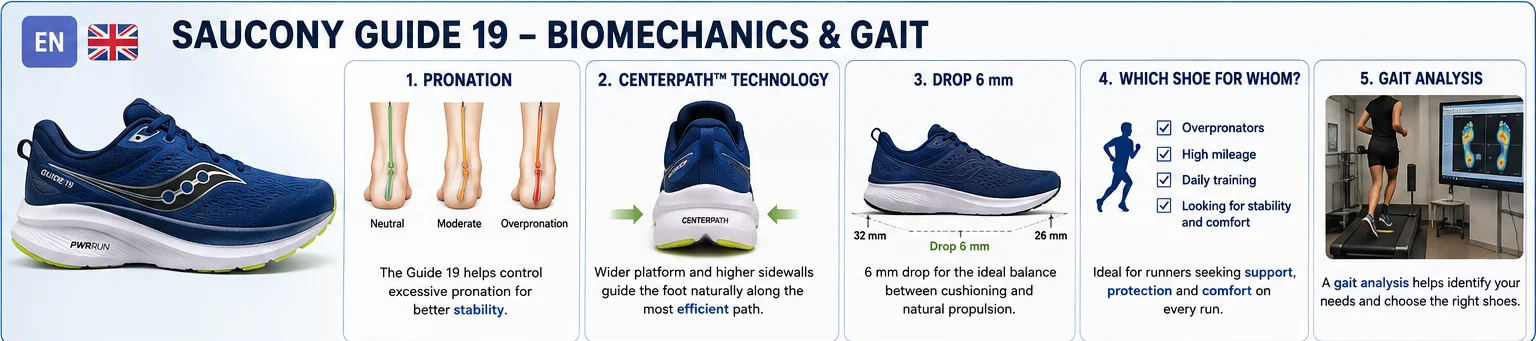
Saucony Guide 19: key specifications
The Guide 19 is primarily designed for everyday road training. The men’s version combines:
- PWRRUN cushioning;
- CenterPath™ guidance geometry;
- approximately 35 mm of stack height at the heel;
- approximately 29 mm at the forefoot;
- a 6 mm drop;
- a weight of around 275 g;
- a relatively broad platform designed to promote comfort and stability.
On paper, these characteristics make it particularly suitable for easy runs, aerobic training, long runs and regular daily mileage. Full specifications are available on our Saucony Guide 19 men’s product page.
But a technical specification sheet alone can never determine whether a shoe will really suit a particular runner.
Pronation is not an abnormality
For many years, running-shoe selection was often reduced to three categories: supinator, neutral or pronator.
Used on its own, this classification is now considered far too simplistic.
Pronation is a natural movement of the foot during stance. When the foot contacts the ground, it adapts to the surface and contributes to the management of mechanical forces. A certain degree of pronation is therefore part of normal running mechanics for many runners.
927 novice runners followed for one year
A prospective study by Nielsen et al., published in the British Journal of Sports Medicine, followed 927 novice runners for one year. All participants ran in neutral shoes.
The researchers did not find a significantly increased injury risk among runners with moderate pronation compared with runners whose foot posture was classified as neutral.1
Being a pronator therefore does not automatically mean that you need a corrective shoe.
This does not mean that foot motion should never be considered. It means that it should be interpreted as part of a broader picture including dynamic movement, training history, comfort, sporting practice and the runner’s response to different shoes.
This is also the approach described in our guide What is gait analysis used for?.
CenterPath™: guiding the stride rather than blocking it
This is where the philosophy behind the Guide 19 becomes particularly interesting.
Historically, some stability shoes used relatively rigid components designed to mechanically limit certain movements of the foot. More recent designs increasingly focus on the overall geometry of the shoe: platform width, sidewalls, foot position and transition through stance.
Saucony calls this approach CenterPath™. On the Guide 19, the system combines a broader platform and geometry intended to provide progressive guidance through the stride.
However, two concepts should be clearly separated:
stability ≠ immobilisation.
A shoe can provide a feeling of stability without completely preventing natural foot motion. This development is consistent with newer paradigms described in the scientific literature on running footwear.2
Can a stability shoe reduce running injuries?
A randomised trial by Malisoux et al., published in the British Journal of Sports Medicine, compared standard running shoes with shoes incorporating a motion-control system.3
The findings suggest that shoe type can influence injury risk and that the effect may vary according to certain characteristics of the runner.
However, this study did not investigate the Saucony Guide 19 specifically. It therefore cannot be used to claim that the Guide 19 prevents injuries.
Its most useful message is broader: the interaction between runner and shoe matters more than any single technology considered in isolation.
PWRRUN: does more cushioning mean more protection?
The Guide 19 uses a PWRRUN midsole. When the runner loads the shoe, the foam deforms and then returns part of the stored energy.
It would be tempting to summarise the relationship as:
more cushioning = less impact = fewer injuries.
Human biomechanics is much more complex than that.
A study involving 848 recreational runners
Malisoux and colleagues studied 848 recreational runners to investigate how shoe cushioning properties could influence injury risk.4
Their work indicates that cushioning characteristics may influence injury risk, while also highlighting the complexity of the interaction between footwear and the runner.
The human body adapts its mechanics to what is placed beneath the foot. Changing the softness or geometry of a shoe may influence leg stiffness, joint motion or the way the foot contacts the ground.
The runner and the shoe therefore function as a system.
A systematic review of running-shoe construction similarly found that different design parameters can modify certain biomechanical variables during running.5
Is the Guide 19’s 6 mm drop better for running?
The Saucony Guide 19 has approximately 35 mm at the heel and 29 mm at the forefoot, producing a 6 mm heel-to-toe drop.
Heel-to-toe drop is the difference in height between the heel and forefoot. But is 6 mm inherently better than 10 mm or 0 mm?
The scientific answer is no: not universally.
553 runners and three different heel-to-toe drops
A randomised study by Malisoux et al. followed 553 runners for six months. Participants used shoes with a heel-to-toe drop of 10 mm, 6 mm or 0 mm.6
Across the overall study population, no significant global difference in injury risk was found between the three groups.
There is therefore no single “best drop” for every runner.
For a deeper explanation, see our article What is heel-to-toe drop in running shoes?.
A major change in drop is not meaningless
The absence of one universally optimal drop does not mean that heel-to-toe geometry is irrelevant.
A substantial change from the geometry a runner is accustomed to can alter the distribution of mechanical loading. Someone who has trained for years in a particular type of shoe may therefore benefit from an adaptation period when making a major change.
A randomised study investigating adaptation to different heel-to-toe drops found that several running-pattern variables could change and that runners progressively adapted over time.7
This is why shoe selection should take the runner’s training and footwear history into account rather than focusing solely on one number in the technical specifications.
Preferred Movement Path: respecting the runner’s natural movement strategy
In 2015, Professor Benno Nigg and colleagues proposed a particularly interesting concept: the Preferred Movement Path.8
According to this hypothesis, every runner has a preferred way of moving. An appropriate shoe should therefore allow the body to remain relatively close to this preferred movement path instead of forcing a completely different mechanical pattern.
The question is no longer simply:
“Are you a pronator?”
It becomes:
“How does your body behave in this shoe?”
Comfort is not a secondary criterion
The same work also proposed the concept of a Comfort Filter: perceived comfort may provide useful information when selecting a running shoe.8
Two shoes with very similar technical specifications can produce very different sensations.
Comfort depends on several factors:
- foot morphology and volume;
- space available in the forefoot;
- heel hold;
- midsole properties;
- shoe geometry;
- perceived stability;
- the runner’s previous footwear habits.
Perceived comfort does not replace biomechanical observation: it complements it.
How should you really choose running shoes?
Scientific evidence increasingly supports a more individualised approach.
Ideally, shoe choice should bring together:
- the runner: morphology, experience and history;
- the gait: dynamic movement while running;
- the intended use: distance, terrain, frequency and goals;
- previous shoes and footwear habits;
- the shoe being tested: cushioning, drop, geometry and stability;
- comfort and sensations.
Our guide How to choose running shoes explains this process in more detail.
Who might the Saucony Guide 19 suit?
Based on its design — and not as a medical prescription — the Guide 19 appears particularly relevant for runners looking for:
- an everyday training shoe;
- comfortable cushioning;
- a relatively stable platform;
- progressive guidance;
- a moderate 6 mm drop;
- a shoe designed for regular mileage.
Its most natural uses include easy runs, aerobic training, recovery runs and long runs.
You can check specifications and availability on the Saucony Guide 19 at Tripp Sport.
Fit and sizing
The Guide 19 has a relatively secure and structured fit, with a broad platform underfoot but without an excessively wide internal volume. Check toe clearance, heel hold and midfoot pressure carefully when trying it on.
As always, the stated size alone is not enough: two runners wearing the same nominal size can prefer different fits depending on foot width, volume and intended distance.
What science does NOT allow us to claim about the Guide 19
It is essential to distinguish scientific evidence from marketing claims.
We cannot scientifically claim that:
- the Guide 19 prevents injuries;
- it automatically “corrects” pronation;
- a 6 mm drop is better for every runner;
- more cushioning necessarily provides more protection.
There is currently no clinical study specific to the Saucony Guide 19 that demonstrates these claims.
What the literature does show is that running-shoe selection is multifactorial.
Gait analysis: bringing theory into the real world
This is precisely why our gait analysis at Tripp Sport is not simply a matter of watching the foot for a few seconds and assigning a label such as “pronator”, “neutral” or “supinator”.
Our process combines observation of previous shoes, foot measurement, treadmill running, video analysis, biomechanical analysis, selection of different models and comparative testing.
The approach can be summarised as:
Observe → Compare → Feel → Choose.
The goal is to find a shoe that fits your gait, morphology, running practice and sensations.
You can also read our educational article What is gait analysis used for?.
Tripp Sport choice in practice
We would recommend the Guide 19 to a runner who wants a stable but non-rigid daily trainer for easy runs, aerobic mileage and long runs, with a fairly natural guidance feel.
We would look at another model first if the runner wants more noticeable support underfoot: in that case, the Mizuno Wave Inspire 22 or Hoka Arahi 9 may make more sense. For a neutral runner mainly seeking plush cushioning without guidance, a Ghost 18 or Glycerin 23 is often the more logical comparison.
Tripp Sport technical verdict
The Saucony Guide 19 reflects the modern philosophy behind stability shoes particularly well.
The aim is no longer simply to block a particular movement of the foot.
Guide → stabilise → accompany.
The combination of PWRRUN, CenterPath™, a broad platform and a 6 mm drop makes it an interesting option for everyday runners seeking comfort and stability.
But the best shoe is not necessarily the one with the most impressive specification sheet.
It is the one that works with your gait.
Guide 19 or another shoe? Test before choosing
If you are hesitating between the Guide 19 and another model, technical information is a useful starting point. Trying the shoes remains essential.
→ Explore the Saucony Guide 19 and its specifications
→ Book a gait analysis at Tripp Sport
This allows you to compare several models and relate their technical characteristics to what is observed while you run — and, above all, to your own sensations.
Independent lab measurements: what they add
RunRepeat measured the Guide 19 at 298 g, with 37.4 mm in the heel, 31.4 mm in the forefoot and a 6.0 mm measured drop, exactly matching Saucony’s stated figure.
The platform is exceptionally broad at roughly 120.0 mm in the forefoot and 104.2 mm in the heel. This gives a concrete explanation for its stability: a wider base reduces tipping without requiring a harsh medial post. It also remains relatively flexible in bending tests, which helps explain its more natural transition compared with older stability shoes.
Independent measurements: RunRepeat.
FAQ
Is the Saucony Guide 19 only for pronators?
No. It is a stability-oriented shoe, but that does not mean it is reserved for runners classified as pronators. Comfort, gait, habits and perceived stability matter more than a simple label.
Is the 6 mm drop suitable for everyone?
No single drop is ideal for every runner. Six millimetres is a moderate value, and any major change from your usual geometry should be introduced progressively.
Can the Guide 19 be used for long runs?
Yes. Its cushioning, broad platform and progressive guidance make it well suited to easy runs, daily mileage and long runs for runners who feel comfortable in it.
Scientific references
- Nielsen RO, Buist I, Parner ET, et al. Foot pronation is not associated with increased injury risk in novice runners wearing a neutral shoe: a 1-year prospective cohort study. British Journal of Sports Medicine. 2014;48(6):440–447. DOI: 10.1136/bjsports-2013-092202.
- Anderson LM, Bonanno DR, Hart HF, Barton CJ. Running Injury Paradigms and Their Influence on Footwear Design Features and Runner Assessment Methods: A Focused Review to Advance Evidence-Based Practice for Running Medicine Clinicians. Frontiers in Sports and Active Living. 2022.
- Malisoux L, Chambon N, Delattre N, Gueguen N, Urhausen A, Theisen D. Injury risk in runners using standard or motion control shoes: a randomised controlled trial with participant and assessor blinding. British Journal of Sports Medicine. 2016;50(8):481–487. DOI: 10.1136/bjsports-2015-095031.
- Malisoux L, Delattre N, Urhausen A, Theisen D. Shoe Cushioning Influences the Running Injury Risk According to Body Mass: A Randomized Controlled Trial Involving 848 Recreational Runners. American Journal of Sports Medicine. 2020. DOI: 10.1177/0363546519892578.
- Sun X, Lam WK, Zhang X, Wang J, Fu W. Systematic Review of the Role of Footwear Constructions in Running Biomechanics: Implications for Running-Related Injury and Performance. Journal of Sports Science & Medicine. 2020;19:20–37.
- Malisoux L, Chambon N, Urhausen A, Theisen D. Influence of the Heel-to-Toe Drop of Standard Cushioned Running Shoes on Injury Risk in Leisure-Time Runners: A Randomized Controlled Trial With 6-Month Follow-up. American Journal of Sports Medicine. 2016;44(11):2933–2940. DOI: 10.1177/0363546516654690.
- Malisoux L, et al. Adaptation of running pattern to the drop of standard cushioned shoes: A randomised controlled trial with a 6-month follow-up. Journal of Science and Medicine in Sport. 2017;20(8):734–739. DOI: 10.1016/j.jsams.2017.01.238.
- Nigg BM, Baltich J, Hoerzer S, Enders H. Running shoes and running injuries: mythbusting and a proposal for two new paradigms: preferred movement path and comfort filter. British Journal of Sports Medicine. 2015;49(20):1290–1294. DOI: 10.1136/bjsports-2015-095054.
Methodological note
The studies cited in this article concern running biomechanics, footwear design and running-related injuries. They are not clinical studies specifically investigating the Saucony Guide 19. They can help explain some of the principles associated with its design but do not demonstrate that this shoe prevents or treats injury.
Persistent pain or injury should be assessed by an appropriate healthcare professional; a shoe analysis is not a substitute for medical advice.